Buying a vehicle from the United States can require you to make high-value decisions from thousands of miles away. Before you send money, learn how to verify a car export company, the exact vehicle, and the payment instructions as separate checks.
You may never visit the company’s office or see the vehicle in person. In some transactions, you may also need to send a deposit or payment before the vehicle begins its journey to you.
That makes independent verification important. A professional-looking website, social media account, vehicle photos, or a convincing salesperson can support confidence, but none of them should be your only proof.
This guide organizes the process into practical checks you can complete before paying, plus warning signs to investigate and steps to take if something looks wrong after a payment.
How to Verify a Car Export Company Before You Pay
Treat the company, the exact vehicle, the written transaction, and the payment instructions as separate layers of verification.
To verify a car export company well, compare information from several independent sources and resolve important inconsistencies before you transfer money.
1. Verify the Car Export Company’s Legal Identity
Start with the basic question: What legal business are you actually dealing with?
Ask the exporter for its full legal company name and the U.S. state where it is registered. Then search the appropriate official state business database and compare the public record with the information the exporter gave you.
Look for consistency in:
- the legal company name;
- business status, where the registry provides it;
- the registered state;
- business address or registered-agent information where publicly available; and
- names connected with the company where the registry provides them.
A business registration does not prove that a company is honest, financially strong, or experienced. It is one identity check. The useful question is whether the business record, website, invoice, contact details, and payment explanation make sense together.
If the website uses one company name, the invoice uses another, and the payment goes to a third name, do not automatically assume fraud. Trade names and separate service providers can be legitimate, but ask for a clear written explanation before you pay.
2. Make Sure You Are Communicating With the Real Company
A real company’s identity can be copied. Someone can register a similar domain, imitate an email address, copy a website, or interfere with a genuine conversation and replace payment instructions.
Before sending money:
- read the full email address, not only the sender’s display name;
- check the domain spelling carefully;
- compare the website address with earlier communications;
- treat unexpected changes in bank details as a reason to re-verify; and
- confirm important payment instructions through a second communication method you already trust.
For example, if new bank details arrive by email, use a phone number or contact channel you independently verified earlier rather than relying only on a new number included in the same message.
A genuine-looking email thread is not, by itself, proof that the latest payment request is genuine.
3. Verify the Exact Vehicle
Do not verify only the company. Verify the car too. Ask for the full Vehicle Identification Number, or VIN, for the specific vehicle you are considering.
Use the VIN to confirm that the vehicle description is internally consistent. For a used vehicle, consider an independent vehicle-history source as another check, while remembering that a history report does not describe every aspect of a car’s present condition.
Compare the VIN across:
- the vehicle description;
- photos supplied for the transaction;
- inspection information;
- the written quotation or invoice; and
- other vehicle records provided to you.
If the VIN changes during the transaction, stop and find out why before proceeding.
4. Ask for Evidence of the Actual Vehicle
Ask for evidence connected specifically to the vehicle you are considering. Polished listing photos alone are weak proof because images can be old, reused, or copied.
Depending on the circumstances, request:
- current photos from several angles;
- interior photographs;
- a clear odometer photo;
- a VIN photo;
- a short current video walkaround; or
- a live video call where the vehicle can be shown.
A reverse-image search can provide another signal. If identical photos appear on unrelated websites under different sellers, investigate further.
Reused images do not automatically prove fraud. Dealers and sourcing companies can legitimately receive photos from vehicle sources, but the company should be able to explain where the images came from and its relationship to the vehicle.
5. Consider an Independent Vehicle Inspection
For a used vehicle, company verification and vehicle-history research still do not tell you the car’s current mechanical condition. An independent inspection can help fill that gap.
For an international buyer, inspecting the car personally may not be realistic. A local mechanic or mobile inspection service may be an option where the seller allows it.
The key word is independent. An inspection arranged by the seller can still be useful, but it is not the same as an inspection performed by someone you selected independently.
If a seller refuses every reasonable attempt to verify a high-value used vehicle, ask why and resolve that concern before moving forward.
6. Get the Transaction Details in Writing
Before paying, make sure you understand exactly what you are paying for. Ask for a written quotation, invoice, agreement, or other transaction record that clearly identifies the deal.
At minimum, you should be able to understand:
- which vehicle the payment concerns;
- the VIN, if a specific vehicle has been selected;
- the agreed vehicle price and the amount being requested now;
- what the current payment covers and whether additional charges may apply;
- which company is receiving the payment;
- what services are included and excluded; and
- the applicable cancellation, refund, or payment terms.
Do not rely on important promises made only during a phone call or chat. International vehicle transactions can involve separate parties for purchasing, inland transportation, freight forwarding, ocean transportation, customs services, or other tasks.
Different parties are not automatically a problem. The problem is not knowing who is responsible for what. Ask for a clear explanation before you pay.
7. Verify the Payment Instructions Separately
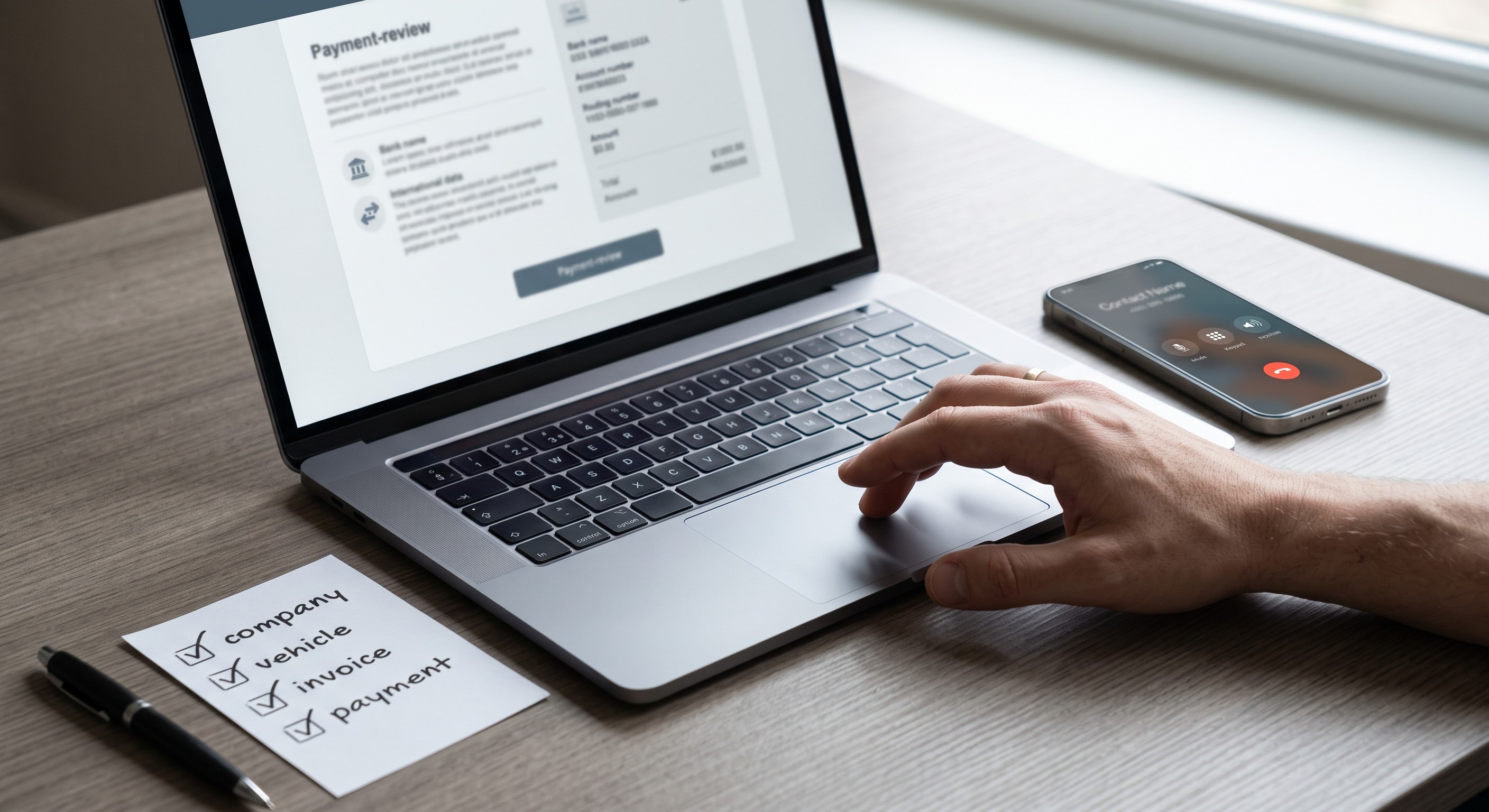
Payment is one of the most important stages of the transaction. Do not treat an invoice as automatically genuine simply because it arrived from an email address you recognize.
Before sending a significant payment, compare three identities:
- Company identity: Who is selling or sourcing the vehicle?
- Invoice identity: Which company appears on the quotation or agreement?
- Payment beneficiary: Who will actually receive your money?
If the names are different, ask why. There may be a legitimate explanation, but you should understand the relationship before transferring funds.
Re-verify the payment if:
- bank details suddenly change;
- a salesperson asks you to ignore an earlier invoice;
- payment is redirected to an unrelated person;
- you are told not to contact other company employees;
- the beneficiary name has no clear explanation; or
- you are pressured to pay before you can verify the information.
International commerce can involve bank transfers. The safety question is whether you independently verified the recipient and the instructions before authorizing the transfer.
8. Verify a Car Export Company Beyond Its Website
A company’s own website is not an independent source. To verify a car export company beyond its own marketing, search for the business, its phone number, and its email address across other sources.
Useful searches can include:
[company name] reviews[company name] complaints[company name] scam[phone number][email address]
Read the substance of the results rather than relying only on a star rating. One unhappy customer does not necessarily mean a company is fraudulent, but repeated reports describing the same problem deserve closer attention.
Patterns worth investigating can include:
- payments followed by no communication;
- vehicles that did not exist;
- unexplained payment-account changes;
- copied listings;
- repeated undisclosed charges; or
- refusal to provide promised documentation.
Also check whether the company’s history appears consistent. Domain age, social-media history, and review history can be supporting signals, but none should be treated as proof on its own.
9. Verify Shipping Credentials When a Company Claims Them
A vehicle exporter and an ocean transportation intermediary are not necessarily the same thing. One company may source or purchase a vehicle while another handles part of the international transportation.
If a company makes a specific claim about holding a shipping or transportation credential, verify that specific claim with the relevant official source. Rules and roles can vary, and regulatory requirements can change over time.
Do not assume every car export company must hold the same credential simply because it helps customers export vehicles. Instead, identify the role the company says it performs and verify that role.
If another shipping company is named in the transaction, verify that company separately as well.
10. Be Careful With Urgency
Time pressure can stop a buyer from checking details. A real vehicle can have another interested buyer and a price can change, so urgency alone does not prove fraud.
Pressure becomes more concerning when it is used to prevent reasonable verification. Examples include:
- Another buyer is sending the deposit right now.
- You have only a short time to pay.
- The bank details changed, so send the money today.
- Do not call the office because this is a special deal.
Urgency should never prevent you from confirming the company, VIN, vehicle, invoice, beneficiary, or bank details. If someone becomes hostile because you want to verify those basics, treat that reaction as useful information about the transaction.
Warning Signs to Check Before Paying
Warning signs
Stop and investigate when one or more important details cannot be explained.
- the company will not provide its legal business name;
- business information cannot be reconciled with official records;
- the VIN is missing or inconsistent;
- photos appear to come from unrelated listings;
- the seller will not provide reasonable evidence of the vehicle;
- important promises exist only in calls or chat messages;
- invoice information changes without explanation;
- bank details change immediately before payment;
- the requested beneficiary has no clear connection with the transaction;
- the seller discourages independent verification;
- you are pressured to send money immediately;
- the seller demands an unusual payment method that is difficult to reverse;
- a supposed protection or escrow arrangement cannot be verified independently; or
- new charges repeatedly appear after you already agreed to a price.
One unusual detail does not always mean a scam. Several unexplained inconsistencies are a reason to stop and verify again.
What to Do If Something Looks Wrong After Payment
Act quickly if a payment, beneficiary, invoice, or communication suddenly appears suspicious after you have paid. Contact your financial institution promptly and explain that you are concerned about possible payment fraud.
Keep copies of the transaction record and do not delete communications even if you believe they may be fraudulent.
Preserve:
- invoices and payment confirmations;
- emails and chat conversations;
- phone numbers and contact details;
- bank instructions;
- vehicle listings and photos;
- VIN information; and
- any agreements or documents you received.
You may also need to report suspected fraud to the appropriate authorities or consumer-protection channels. The correct reporting route depends on what happened and where the parties are located.
Final Checklist Before You Send Money
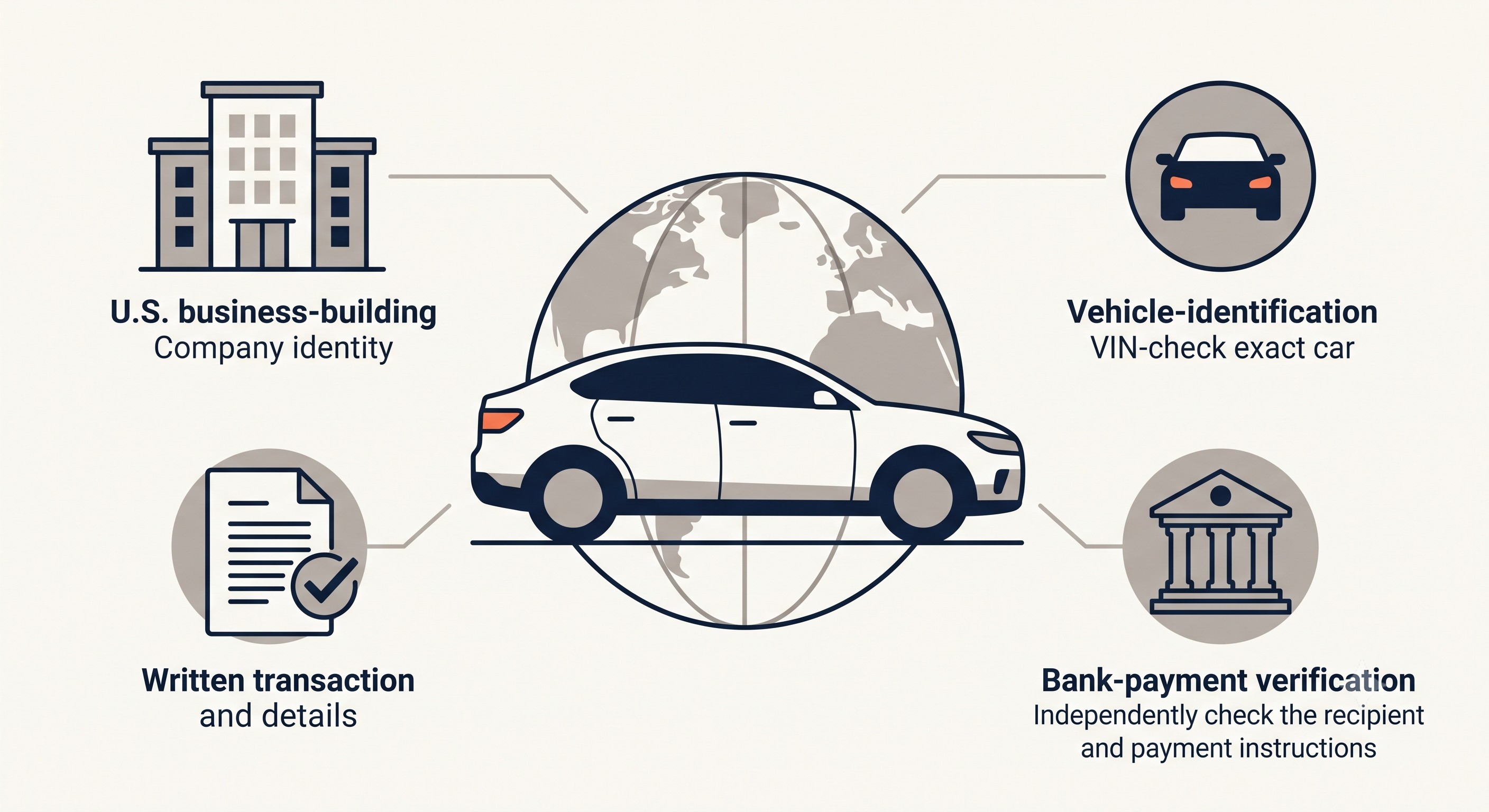
Final check
Company
- Did I confirm the legal company identity?
- Did I check an independent government or business source?
- Do the company name, website, contact details, and invoice make sense together?
Vehicle
- Do I have the correct VIN?
- Does the VIN match the vehicle description?
- Did I obtain independent vehicle-history information?
- Did I receive reasonable evidence of the actual vehicle?
- Did I consider an independent inspection?
Transaction
- Do I understand exactly what I am paying for?
- Are important terms written down?
- Do I know which company is responsible for each part of the transaction?
Payment
- Did I verify the beneficiary?
- Did I independently confirm the payment instructions?
- Have the bank details changed?
- Am I being pressured to pay before completing my checks?
If you cannot answer these questions clearly, do not rush the transfer. Ask for clarification and verify a car export company, the vehicle, the transaction, and the payment details again before you send money.
Frequently Asked Questions
Ask for the company’s full legal name and state of registration, then search the official business registry for that state. Compare the record with the website, invoice, and contact information you received. Registration confirms an identity record, but it does not by itself prove that the company is trustworthy, experienced, or financially secure.
No. Treat registration as one part of a broader verification process. Check the company’s contact details, the exact vehicle and VIN, independent vehicle-history information, reputation, written transaction terms, and payment instructions. Confidence should come from several independent checks that agree with one another, not from a single document or website.
Do not judge the transaction from the payment method alone. Before a bank transfer, independently verify the company, invoice, beneficiary, and payment instructions. Be especially careful when bank details change unexpectedly or when someone pressures you to pay before you can confirm the new information through a trusted communication channel.
Ask for the VIN and enough current evidence to confirm that the vehicle being discussed is the same one described in your agreement. Compare the VIN across the listing, photos, inspection information, and invoice. For a used vehicle, consider independent vehicle-history information and a mechanical inspection where practical.
No. Companies involved in an export transaction can perform different roles, and the requirements for those roles can differ and change over time. If a company makes a specific claim about a shipping or transportation credential, identify the role it says it performs and verify that particular claim with the relevant official source.
Reviews can help, but they should not be your only evidence. Search several independent sources and read the details behind ratings. Look for repeated patterns such as missing vehicles, unexplained payment changes, copied listings, undisclosed charges, or failure to provide promised documents. Treat review history as a supporting signal rather than proof by itself.