A U.S. vehicle listing can tell you a lot about a car, but it should be treated as a starting point, not as proof that every detail is correct.
Check these first
Before you become interested in the price or appearance, check three things:
- What vehicle is actually being offered?
- What does the listing tell you about its condition and history?
- Which important details still need to be verified?
This matters even more when you are buying from outside the United States. You may not be able to see the vehicle yourself before making a decision, so small inconsistencies in a listing deserve attention.
Use this guide to read a U.S. vehicle listing systematically before you move to the next step.
1. Confirm the Vehicle’s Basic Identity
Start with the facts that identify the vehicle.
A typical listing may show:
- year;
- make;
- model;
- trim;
- body style;
- engine;
- drivetrain;
- mileage;
- exterior and interior color;
- stock number; and
- Vehicle Identification Number, or VIN.
Do not assume that a stock number and a VIN are the same thing. A stock number is normally an identifier created by the seller or inventory system. The VIN identifies the vehicle itself.
NHTSA describes the VIN used under current U.S. standards as a 17-character identifier that contains information about the vehicle. Its official VIN decoder can help confirm details encoded in the VIN.
Check that the details agree
Compare the listing title with the specification section.
For example, if the headline says:
2022 Ford Explorer Limited
but another section says:
Trim: XLT
that difference needs an explanation.
The same applies to engine size, drivetrain, model year, and other important specifications.
A mismatch does not automatically mean there is a serious problem. Listing databases can contain mistakes. But you should resolve the difference before making a purchase decision.
2. Pay Attention to the Exact Trim and Equipment
The model name alone may not tell you exactly what you are buying.
Different trims of the same vehicle can have different:
- engines;
- transmissions;
- safety equipment;
- interior materials;
- infotainment systems;
- seating configurations;
- wheels;
- towing equipment; and
- driver-assistance features.
Do not rely only on a long list of features in the advertisement.
Some vehicle-listing systems automatically populate equipment information from a VIN, trim, or database, and those details can sometimes be inaccurate.
If a specific feature matters to you, verify that the individual vehicle actually has it.
Useful evidence may include:
- clear photographs;
- the VIN;
- manufacturer information;
- an original vehicle specification or window sticker when available; or
- direct confirmation from the seller.
For example, if you need a third seating row, four-wheel drive, a specific engine, or a particular safety feature, do not assume it is present because similar versions of the model have it.
3. Read the Mileage as One Part of the Vehicle’s Story
Mileage is important, but a mileage number alone does not tell you whether a vehicle is a good purchase.
First, find the exact mileage shown in the listing.
Then ask:
- Is the mileage current?
- Is there a photograph of the odometer?
- Does the mileage shown in the photos match the written listing?
- Does the vehicle-history information support the mileage?
- Does the amount of visible wear seem reasonable for that mileage?
The National Motor Vehicle Title Information System, or NMVTIS, can provide the latest reported odometer information available in its records. The FTC also recommends getting a vehicle-history report before buying a used vehicle.
A vehicle with lower mileage is not automatically better than one with higher mileage. Maintenance, prior use, age, storage, damage, and overall condition also matter.
Treat mileage as one piece of evidence, not as the final answer.
4. Understand What the Listing Says About the Title
A listing may use terms such as:
- clean title;
- salvage;
- flood;
- junk; or
- another title or vehicle-history description.
These words deserve careful attention.
In the United States, title-brand rules and terminology are not completely uniform between states. The Department of Justice explains that states have their own laws, standards, and terminology for vehicle titles and brands. NMVTIS keeps reported brand history so buyers can see information that may not be obvious from a current paper title alone.
That means a simple statement such as “clean title” in an advertisement should not be your only check.
For a used vehicle, verify the VIN against a reliable history source and review the available title and brand information before making a decision.
NMVTIS reports can include information about the current title, brand history, the latest reported odometer reading, and certain insurance, junk, and salvage records.
Check this first
The important principle is simple:
Read the title description in the listing, then verify it independently.
5. Study the Photos for Information, Not Just Appearance
Vehicle photos are not only there to show whether you like the color.
They can help you understand what the written description does not explain.
Look for photographs showing:
- front, rear, and both sides;
- all four corners;
- wheels and tires;
- seats and interior surfaces;
- dashboard;
- odometer;
- instrument panel with the vehicle on, when available;
- cargo area or trunk;
- engine compartment;
- visible scratches, dents, or damage; and
- any problem specifically mentioned in the description.
Look for what is missing
If the listing has many exterior photos but no interior photos, ask why.
If damage is mentioned but never shown, request a clear close-up.
If the description says the interior is in excellent condition but the available photos are too dark to judge it, do not treat the description as verification.
Missing photos do not automatically prove that a seller is hiding something. They tell you which questions to ask next.
6. Separate Seller Descriptions From Verifiable Facts
Words such as these are common in vehicle listings:
- excellent;
- clean;
- well maintained;
- like new;
- great condition;
- fully loaded; or
- runs perfectly.
These descriptions may be useful, but they are subjective.
A better approach is to translate each claim into something you can verify.
Instead of accepting:
“Well maintained.”
Ask whether maintenance records are available.
Instead of relying on:
“Excellent tires.”
Look at clear tire photographs or request information about their condition.
Instead of accepting:
“No problems.”
Use a vehicle-history report and, where practical, an independent inspection.
The FTC specifically advises that a vehicle-history report is not a substitute for an independent mechanical inspection, because history reports may not contain mechanical problems that have never been reported.
7. Check the VIN Before You Get Attached to the Vehicle
The VIN is one of the most useful pieces of information in a U.S. vehicle listing.
Once you have it, you can use independent sources to check different parts of the vehicle’s identity and history.
Decode the VIN
NHTSA provides a public VIN decoder that can identify information reported by the manufacturer, including vehicle characteristics and manufacturing information.
Compare the decoded result with the advertisement.
If the VIN identifies a different model, engine, model year, or other important characteristic, investigate the difference before continuing.
Check vehicle history
The FTC recommends starting with NMVTIS-approved vehicle-history information. NMVTIS can provide title, odometer, brand, and certain loss or salvage information. Other commercial reports may contain additional records.
No single history database should be treated as a complete mechanical inspection.
Check recalls
NHTSA allows buyers to search a VIN for certain unrepaired safety recalls. Its VIN search also explains important limits: for example, it does not show recalls that have already been repaired and may not show every recently announced recall immediately.
That makes a recall check useful, but it is not a complete vehicle-condition report.
8. Do Not Read the Advertised Price in Isolation
The price shown at the top of a listing is important, but first determine exactly what the number represents.
Ask:
- Is this the actual advertised vehicle price?
- Are any advertised discounts conditional?
- Is financing required to receive that price?
- Are there required dealer charges not obvious from the listing?
- Is the same price confirmed when you contact the seller?
For a dealer purchase, clarify what the advertised number includes, whether any discount is conditional, and which charges are mandatory. Ask for the full price in writing before you commit so you can compare the vehicle price with the rest of your cross-border budget.
For an international buyer, it is also important to keep the vehicle purchase price separate in your mind from the rest of your cross-border budget.
A vehicle listing is not a complete estimate of everything that may be involved in getting a vehicle to your destination. Verify those separate requirements and costs for your own transaction rather than assuming they are included in the advertised vehicle price.
9. Look for the FTC Buyers Guide on Dealer-Sold Used Cars
When a used vehicle is being sold by a dealer covered by the FTC Used Car Rule, an important document is the Buyers Guide.
The FTC says dealers subject to the rule must display a Buyers Guide on used vehicles they offer for sale. Buyers purchasing a used vehicle online are also entitled to the Guide.
The Buyers Guide helps explain matters such as:
- whether the vehicle is being sold “as is” or with a dealer warranty;
- certain warranty coverage information;
- major vehicle systems and potential problems;
- the importance of getting promises in writing; and
- the recommendation to obtain a vehicle-history report and independent inspection.
Do not confuse a listing description with the Buyers Guide.
If the sale is through a U.S. dealer, review the relevant purchase and warranty documents rather than relying only on the online advertisement.
10. Compare the Written Description With the Photos and Data
One of the simplest ways to evaluate a listing is to look for consistency.
Suppose the listing says:
- 42,000 miles;
- black interior;
- four-wheel drive;
- no visible damage.
Now compare that with:
- the odometer photo;
- interior photos;
- decoded VIN information;
- specification fields; and
- exterior photos.
If everything agrees, you have a more coherent picture of the vehicle.
If several details conflict, stop and get clarification.
A good listing does not need to be perfect. It does need to give you enough reliable information to know what you are considering.
11. Know What a U.S. Vehicle Listing Cannot Tell You
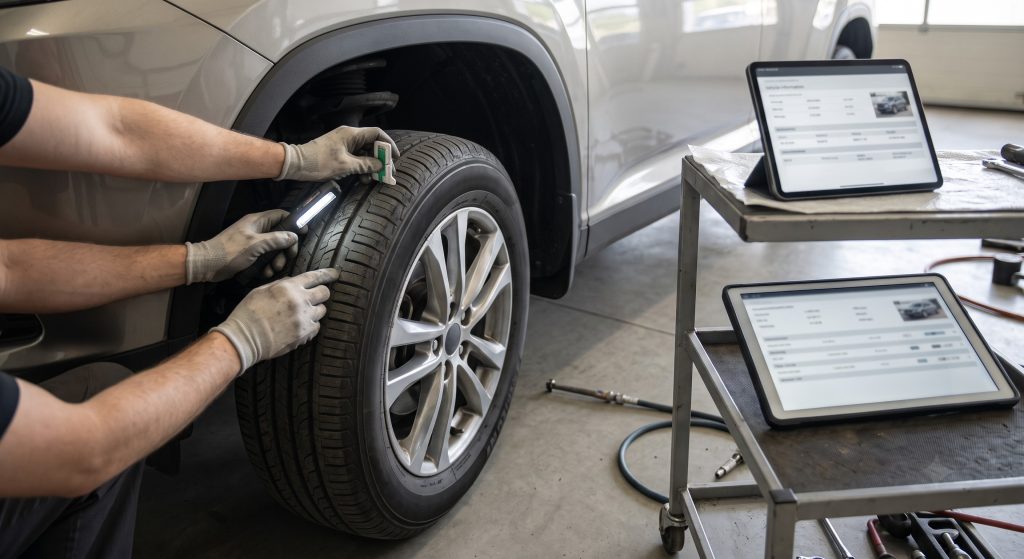
Even a detailed listing has limits.
It cannot reliably tell you everything about:
- mechanical condition;
- hidden body repairs;
- noises or driving behavior;
- fluid leaks;
- electronic faults;
- maintenance quality; or
- problems that were never documented.
That is why the FTC recommends an independent inspection even when a vehicle has been described as certified or has a vehicle-history report.
Key Takeaway
For a remote buyer, a polished advertisement should never replace verification. Use the listing to decide what deserves further investigation, then confirm the important details through documents, history sources, seller evidence, and an independent inspection when appropriate.
A 60-Second U.S. Vehicle Listing Checklist
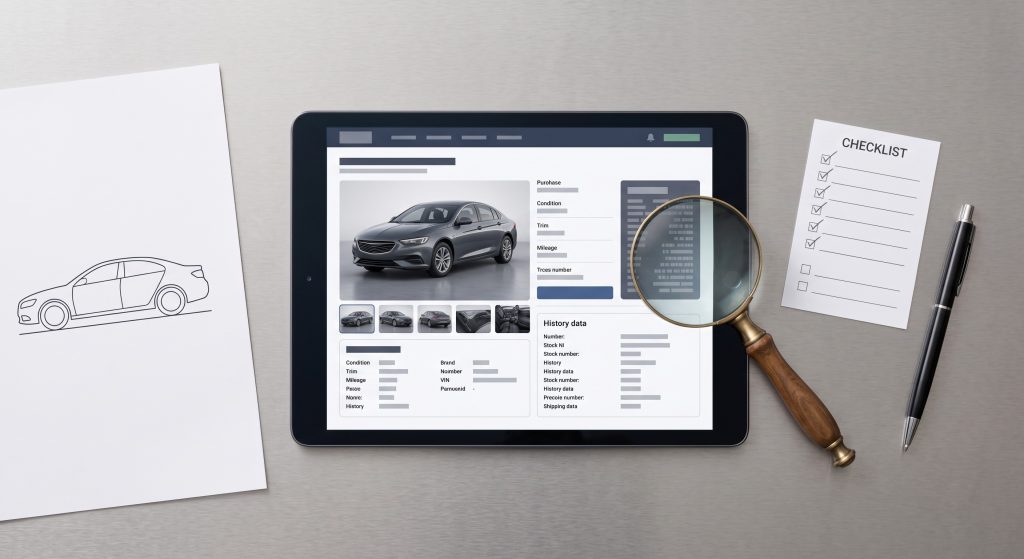
Before moving forward with any vehicle, review these items:
| Listing item | What to confirm |
|---|---|
| Year, make and model | Do all sections of the listing agree? |
| Trim | Is the exact trim clearly identified? |
| VIN | Is it available, and does it decode to the advertised vehicle? |
| Mileage | Does the written mileage agree with photos and history records? |
| Title information | What title status or brand is stated, and has it been independently checked? |
| Condition | Are claims supported by detailed photos or other evidence? |
| Features | Are important options actually visible or verified? |
| Photos | Are all major areas of the vehicle shown clearly? |
| Price | What exactly does the advertised number include? |
| Buyers Guide | If applicable to a dealer sale, is it available for review? |
| Vehicle history | Has the VIN been checked through an appropriate history source? |
| Recalls | Has the VIN been checked with NHTSA? |
| Inspection | Is independent inspection information available or feasible? |
If several answers are “I don’t know,” the next step should usually be more verification, not a faster decision.
Extra Advice for International Buyers
A U.S. listing is primarily describing a vehicle being offered for sale.
It should not be treated as proof that the vehicle meets the rules, registration requirements, taxes, duties, technical standards, or import requirements of your destination.
Those requirements can differ by jurisdiction and may change. Verify destination-specific requirements separately with the relevant authorities or appropriately qualified professionals before committing to a purchase.
This also means you should avoid choosing a vehicle only because the U.S. listing looks attractive.
First determine that it is the right vehicle.
Then determine whether the overall purchase makes sense for your situation.
Before You Buy: Verify the U.S. Vehicle Listing
The best way to read a U.S. vehicle listing is not to search for one magic detail.
Look at the complete picture:
- confirm the vehicle’s identity;
- check the VIN;
- compare the mileage;
- understand the title information;
- study the photographs;
- verify important equipment;
- understand the advertised price;
- review available history and recall information; and
- use an independent inspection when appropriate.
A listing helps you decide whether a vehicle deserves further investigation. It should not be the end of that investigation.
Frequently Asked Questions
No. A VIN check can help confirm the vehicle’s identity and can point you toward title, history, odometer, or recall information, depending on the source you use. It does not establish the car’s present mechanical condition. Review the available history and arrange an independent inspection when practical before making a purchase decision.
Treat “clean title” as a listing description that still needs independent verification. Title laws, brands, and terminology can vary between U.S. states, and a current description may not tell the whole history. Check the VIN through an appropriate vehicle-history source and review the available title and brand information before you rely on that claim.
Use the listed mileage as a starting point, not as the only evidence. Compare it with a clear odometer photograph, the seller’s current information, and any available vehicle-history records. Also consider whether the visible wear and documented history make sense together, because mileage alone does not establish overall condition or maintenance quality.
Yes, an independent inspection can still add important information. A vehicle-history report depends on records that were reported to the database and may not reveal current mechanical faults, hidden repairs, leaks, noises, or maintenance issues. A good report is useful evidence, but it should not be treated as a substitute for checking the vehicle’s present condition.
The Buyers Guide is a disclosure used for many dealer-sold used vehicles when the FTC Used Car Rule applies. It can indicate whether the dealer is offering the vehicle “as is” or with warranty coverage and provides other consumer information. For an online dealer purchase, ask to review the applicable Buyers Guide and purchase documents before committing.