A U.S. vehicle listing can tell you a lot about a car. It can also leave important questions unanswered.
That matters even more when you are buying from outside the United States. You may be looking at a vehicle thousands of miles away, without the option to see it yourself before making a decision.
Core safety rule
The best approach is to treat the listing as a starting point for verification, not as proof that everything about the vehicle is correct.
Before you focus on whether you like the car, check its identity, VIN, mileage, history, condition information, photos, price, and sale terms. Then look for anything that is missing or inconsistent.
This guide explains how.
What should you check first in a U.S. vehicle listing?
Start with the basic facts that identify the exact vehicle:
- model year
- make
- model
- trim or series
- mileage
- VIN
- engine
- transmission
- drivetrain
- body style
- listed price
- vehicle location
- current availability or listing status
Do not assume two vehicles with the same year, make, and model are identical.
Different trims can have different engines, drivetrains, safety equipment, interior features, wheels, and other specifications. Those differences can affect both the value of the vehicle and whether it is the version you actually want.
If an important specification is missing, make a note of it. A good listing does not need to answer every possible question, but you should know which facts still need confirmation before you move forward.
1. Check the VIN before trusting the specifications
The Vehicle Identification Number, or VIN, is one of the most useful pieces of information in a U.S. vehicle listing.
For modern vehicles, the VIN is normally a 17-character identifier. NHTSA provides a public VIN decoder that can identify manufacturer-reported information about a vehicle, including details such as model year, make, model, body type, engine information, and manufacturing plant when available.
Use the VIN to check whether the basic vehicle information agrees with the listing.
For example, compare:
- model year
- make and model
- trim, when available
- engine
- drivetrain
- body type
A difference does not automatically mean there is a serious problem. Listings can contain data-entry errors, and VIN decoders do not always contain every specification.
But an inconsistency is something to resolve before buying.
What if the VIN is not shown?
Ask for it before you spend significant time evaluating the vehicle.
Without the VIN, you cannot independently check many of the most important records connected with that particular vehicle.
A missing VIN alone does not prove that a listing is dishonest. However, if the seller or dealer will not provide the VIN when you are seriously considering the vehicle, you have much less information available to verify what you are being told.
2. Read the mileage as something to verify
Mileage is easy to notice because it is usually displayed prominently.
Do not stop at the number in the advertisement.
Compare the listed mileage with other available evidence, such as:
- a clear photo of the odometer
- the latest mileage shown in a vehicle history report
- service or maintenance records, when available
The U.S. National Motor Vehicle Title Information System, or NMVTIS, includes the latest reported odometer reading in its vehicle-history information. That can help buyers identify possible inconsistencies.
Mileage also needs context.
A low number does not automatically prove that a vehicle is in excellent condition. A higher number does not automatically make a vehicle unsuitable.
Maintenance, previous use, age, mechanical condition, damage history, and inspection findings all matter.
Think of mileage as one part of the vehicle’s story rather than a final judgment.
3. Do not treat “clean title” as the end of your research
Listings often contain short statements about title status.
These statements deserve verification.
U.S. state motor vehicle agencies can apply brands to vehicle records. NMVTIS describes brands as labels relating to vehicle status or history, with examples including junk, salvage, and flood designations. Its reports can include title-state information, brand history, odometer data, total-loss information, and salvage history.
This is important because a short phrase in a listing does not tell you the full history.
For example, a listing that says “clean title” should not be interpreted as proof that the vehicle has never been damaged or involved in an accident.
NMVTIS itself is intentionally focused on a limited set of title, brand, odometer, total-loss, and salvage indicators. It does not contain every type of information that may be available elsewhere, such as complete repair history.
Check this first
The better question is:
What do the available records show about this specific VIN?
4. Use a vehicle history report to check the listing
Once you have the VIN, compare the advertisement with independent vehicle-history information.
The FTC recommends obtaining a vehicle history report before buying a used vehicle. It directs consumers to NMVTIS for title, insurance-loss, and salvage information while noting that other history providers may contain additional records such as accident or repair information.
Look for consistency between the report and the listing.
Check items such as:
- vehicle identity
- odometer records
- title and brand history
- reported total-loss or salvage information
- accident information when available
- ownership or registration history when available
Do not expect one database to tell you everything.
A history report is another verification layer. It is not a replacement for examining the vehicle’s current condition.
5. Study the photos for information, not just appearance
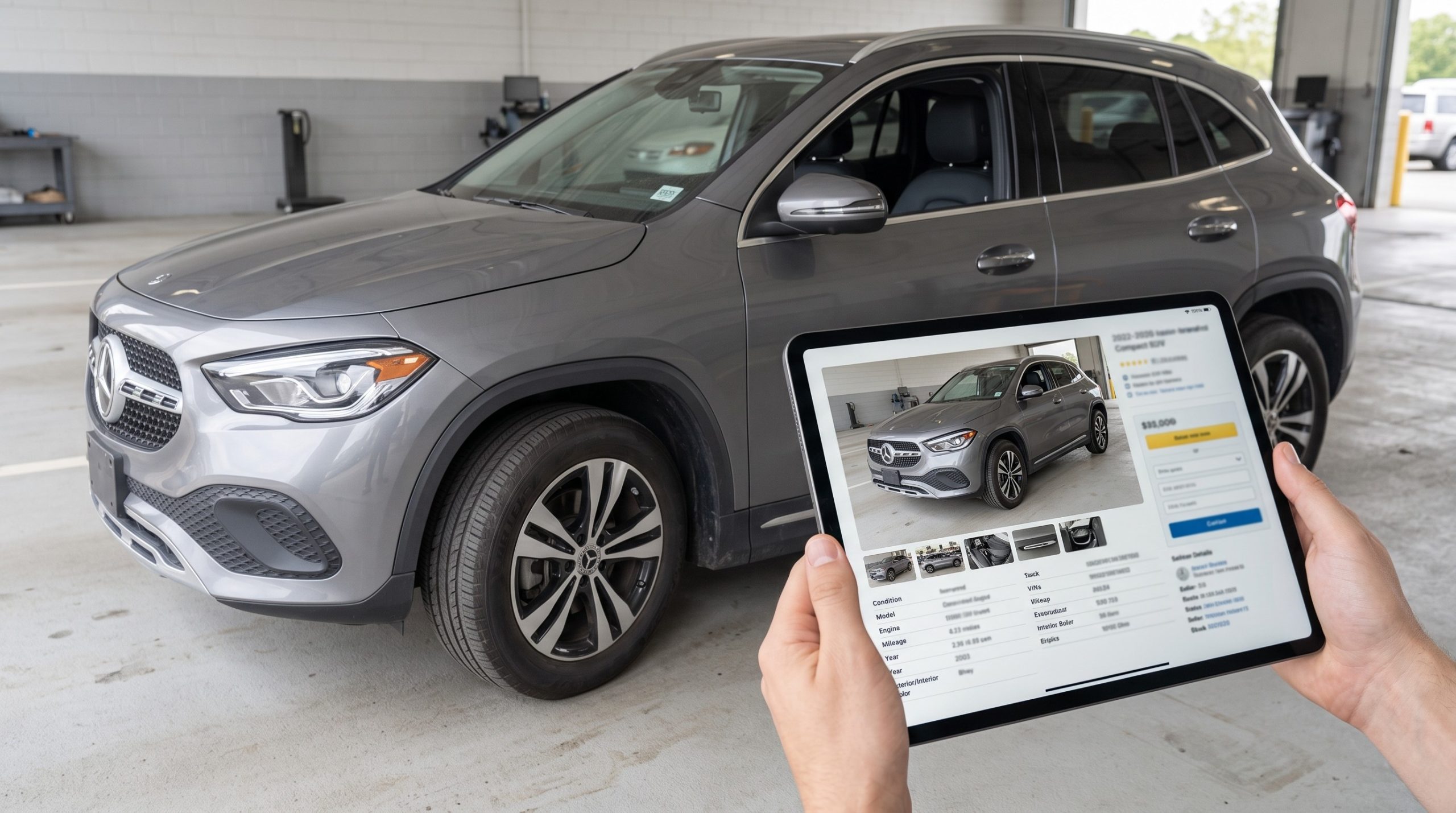
Vehicle photos are often the first thing buyers look at.
Instead of asking only, “Does this car look good?”, ask:
What has the seller shown me, and what has not been shown?
A useful photo set may include:
- front
- rear
- both sides
- all four corners
- wheels and tires
- driver’s seat and controls
- front and rear seating areas
- dashboard
- odometer
- cargo area or trunk
- engine compartment
- close-ups of visible scratches, dents, or other damage
- underbody or lower-body areas when relevant and available
You do not need every listing to contain every one of these photographs.
The point is to identify gaps.
If the description mentions damage on one side of the vehicle but that area is not clearly photographed, ask for additional images.
If every photograph is taken from far away, request close-ups.
If warning lights are visible on the dashboard, ask what they mean rather than guessing.
Missing photos are not proof that someone is hiding a problem. They are simply a reason to request more information.
6. Separate objective facts from advertising language
Vehicle descriptions often mix factual specifications with subjective language.
For example:
More objective:
- 62,400 miles
- automatic transmission
- all-wheel drive
- 2.0-liter engine
- VIN provided
More subjective:
- excellent condition
- runs perfectly
- very clean
- like new
- needs nothing
Subjective descriptions may be completely sincere. They are simply difficult to verify from words alone.
When a statement affects your buying decision, look for evidence.
If the listing says the vehicle has been well maintained, ask whether maintenance records are available.
If it says there is no damage, compare that statement with the photos, history information, and inspection findings.
If it lists an important option, make sure the exact trim or VIN information supports it when possible.
The more important the claim is to your decision, the less you should rely on advertising language alone.
7. Understand exactly what the listed price means
A large price number can make a listing feel simple.
The real question is:
What does that number include?
If the vehicle is being sold by a dealer, ask for clear written information about the total vehicle price and any additional charges or optional products.
The FTC specifically advises used-car buyers to ask about the total price and to review dealer add-ons rather than assuming the advertised figure represents every amount involved in the transaction.
Before you pay
For an international purchase, keep the vehicle purchase price separate in your mind from other possible costs connected with moving, exporting, importing, taxing, registering, or preparing the vehicle.
Those costs can depend on the transaction and destination. Do not assume they are included simply because a U.S. listing shows one price.
Verify them separately before making a financial commitment.
8. If it is a dealer listing, ask for the Buyers Guide
If the vehicle is being sold by a U.S. dealer, there is another document international buyers should know about: the FTC Buyers Guide.
FTC consumer guidance says dealers must provide a Buyers Guide for the used vehicles they sell, including vehicles purchased online. The Guide explains whether the vehicle is being sold with a dealer warranty or “as is,” among other information.
One useful detail is often misunderstood:
“As is” refers to the dealer warranty position. It should not be read as a statement about the vehicle’s history, title, or mechanical condition. The FTC specifically clarified this point when it revised the Used Car Rule.
The Buyers Guide also encourages buyers to obtain a vehicle history report and an independent inspection.
So do not use the Buyers Guide as a substitute for checking the vehicle itself.
It is another piece of the purchase information.
9. Check for open safety recalls
The VIN can also be used to check recall information.
NHTSA provides a recall search that can show whether a specific VIN has an unrepaired safety recall reported through its system.
If a recall appears, find out:
- what the recall concerns
- whether the repair has already been completed
- if not, how it will be handled
This check is separate from the listing and separate from the vehicle history report.
That is why reviewing a vehicle through several independent sources is more useful than relying on one screen of information.
10. Do not replace an inspection with a history report
A history report tells you about recorded events.
An inspection tells you about the vehicle’s condition now.
They are not the same thing.
The FTC specifically warns that a vehicle history report is not a substitute for an independent mechanical inspection. A history report may contain accident or flood information while still not identifying current mechanical problems.
When practical, arrange for an independent inspection before making the final purchase decision.
This becomes especially useful when you are buying remotely and cannot inspect the vehicle yourself.
The inspection should be tied to the exact vehicle and VIN you are considering.
11. Look for inconsistencies instead of searching for one perfect “red flag”
Many buyers want a simple sign that tells them whether a listing is safe or unsafe.
Real listings are rarely that simple.
A better method is to look for information that does not agree.
Examples include:
- the VIN identifies a different trim from the advertisement
- the mileage in the listing conflicts with another recent record
- the description mentions damage that is not visible in the photos
- photos show damage that the description does not mention
- a title claim is not supported by the available history
- important specifications change between different parts of the listing
- the seller cannot clearly explain what the advertised price includes
- a dealer will not provide expected documents or allow reasonable independent verification
One small error may be innocent.
Several unexplained inconsistencies deserve more caution.
Your goal is not to prove that the seller is wrong. Your goal is to reach a point where the important facts are clear enough for you to make an informed decision.
12. Know what a U.S. vehicle listing does not tell you
For an international buyer, this is especially important.
A U.S. vehicle listing normally describes the vehicle and sale opportunity in the United States.
Do not treat it as proof that:
- the vehicle is eligible for import into your country
- it meets your country’s technical or registration requirements
- a particular customs treatment will apply
- a certain tax or duty amount will apply
- a particular shipping method or route is available
- the advertised vehicle price represents your complete delivered cost
Those questions need separate verification based on your destination and transaction.
This separation keeps you from confusing a good vehicle listing with a complete international purchase plan.

A simple used-car listing checklist
Before you move forward with a U.S. vehicle, ask whether you can answer these questions:
- Do I know the exact year, make, model, and trim?
- Do I have the VIN?
- Does the VIN information agree with the listing?
- Does the mileage agree with available records?
- Have I checked title and vehicle-history information?
- Do the photos show the important parts of the vehicle clearly?
- Have I asked about anything missing or inconsistent?
- Do I understand what the listed price includes?
- Have I checked for unrepaired safety recalls?
- Have I considered an independent inspection before the final decision?
- Have I separately verified the requirements and costs that apply to my destination?
If several answers are “no,” you probably need more information before making an offer or sending money.
The listing is only the first layer
A useful U.S. vehicle listing helps you decide whether a car deserves a closer look.
It should not make the decision for you.
Start with the listing. Confirm the VIN. Compare the mileage. Review available history. Examine the photos. Understand the price and sale terms. Check recalls. Then use independent verification where it matters.
That process is especially valuable when you are shopping internationally and cannot simply drive across town to see the vehicle yourself.
Verify the vehicle before you buy
A U.S. vehicle listing is most useful when it gives you enough information to verify the car, not when it asks you to trust the advertisement on its own. Confirm the identity, resolve inconsistencies, and separate the U.S. sale from destination-specific import requirements before you commit funds.
Visit Export Auto USAFrequently asked questions
Start by confirming the exact vehicle: model year, make, model, trim, mileage, and VIN. The VIN is especially useful because it lets you compare the advertisement with independent vehicle information. If basic identity details do not match, resolve the difference before you rely on the rest of the listing.
No. A title record and an accident history are not the same thing. Title and brand information can reveal important status changes, but it may not capture every collision, repair, or current condition issue. Compare available history sources and, when practical, use an independent inspection before making a final purchase decision.
No. The VIN helps identify the vehicle and supports useful title, history, and recall checks, but it does not describe every aspect of the car’s present condition. Use VIN-based information together with clear photos, maintenance records when available, seller answers, and an independent inspection when practical.
A favorable history report is useful, but it should not be your only check. Vehicle-history databases contain recorded information and can have gaps. Review the listing, photos, mileage, title information, recall status, and current condition separately. An independent inspection can help identify mechanical or physical issues that may not appear in a report.
Treat as-is language as information about the dealer’s warranty position, not as proof of the vehicle’s history or present condition. You should still verify the VIN, title information, mileage, available history, recalls, photos, sale terms, and current condition. For a remote purchase, independent verification can be especially valuable.