Before buying a vehicle from the United States, ask your U.S. car exporter clear questions about the company, the vehicle, the price, the payment process, the documents, and the destination rules. You may have to commit money before seeing the vehicle in person, so the exporter matters almost as much as the car.
The goal is not to remove every possible risk. It is to understand what you are buying, who is receiving your money, which services are included, and who is responsible when the vehicle moves from purchase to export.
A reliable U.S. car exporter should be able to answer reasonable questions clearly and put important details in writing before you commit.
What to check before buying from a U.S. car exporter
The company: know the legal business name, the contact details, the name on the invoice, and the person or company receiving payment.
The vehicle: confirm the VIN, current condition information, title status, available history, and whether an independent inspection is possible.
The process: understand what the quote includes, who handles each step, which documents you will receive, and what happens if the transaction changes.
Use the following 10 questions to make the transaction easier to verify before you send money.
1. Who is the U.S. car exporter you are paying?
Start by confirming the exact business behind the transaction. Ask for the legal business name, business address, main contact information, the name that will appear on the invoice, and the name of the company or person that will receive payment.
- Legal business name and business address
- Main phone number and email contact
- Name that will appear on the invoice
- Name of the payment recipient or beneficiary
Then compare the details. If the website uses one business name, the invoice uses another, and the payment instructions name an unrelated third party, ask for a written explanation before proceeding. Different legal entities can be involved legitimately, but the relationship should be clear.
What a good answer looks like
The exporter gives you a clear legal identity and contact information, and those details remain consistent across the invoice, payment instructions, and transaction record.
Warning signs
- The seller avoids giving a legal business name.
- The invoice and payment recipient cannot be explained clearly.
- Company details conflict across the website, invoice, or messages.
- You are pressured to pay before basic business details can be verified.
2. What exactly will the exporter do for me?
The word exporter can describe different business models. One company may own the vehicle, another may source it from a dealer or auction, and separate providers may handle inland transportation, documents, or international shipping.
Ask where the exporter’s responsibility begins and ends.
- Are you selling the vehicle directly or buying it from another seller on my behalf?
- Do you arrange or permit an independent inspection?
- Who handles transportation inside the United States?
- Who prepares or submits U.S. export documents?
- Who books international shipping?
- Which services are performed by other companies?
Define the handoffs
A useful answer names the responsible party at each stage. A vague promise that the company “handles everything” is not enough unless the company explains what that includes and which parts are handled by third parties.
3. Can you give me the VIN and current vehicle information?
Before committing to a specific vehicle, ask for its Vehicle Identification Number (VIN). The VIN gives you a consistent identifier for comparing the seller’s information with independent sources.
- Year, make, model, and trim
- Current mileage
- Current photos and known condition
- Known damage or previous repairs
- Current location, when appropriate
- Available service or maintenance information
For U.S. vehicles, you can also use the NHTSA recall lookup to check for certain unrepaired safety recalls.
What to verify
The U.S. car exporter should provide enough identifying information for you to research the vehicle before making a final decision. Be cautious if basic details remain unavailable, conflict with each other, or keep changing.
4. What does the title and vehicle history show?
Photos cannot show a vehicle’s full history. For a used U.S. vehicle, ask about the current title status, previous title brands, reported odometer information, known accident or damage history, and salvage or total-loss records where available.
The U.S. Department of Justice’s National Motor Vehicle Title Information System (NMVTIS) can provide title-related information from participating sources, but no history database should be treated as a complete mechanical or repair record.
Whenever possible, obtain vehicle-history information independently instead of relying only on a screenshot or summary supplied by the seller.
History checks are one layer
- Confirm that the VIN on the report matches the vehicle.
- Ask for an explanation of any title brand or unclear title status.
- Use history information together with current condition evidence.
- Investigate further if the seller discourages independent checks.
5. Can I arrange an independent inspection?

A vehicle history report cannot confirm the car’s complete present mechanical condition. For a used vehicle, ask whether an independent mechanic or inspection service can examine it before purchase.
Depending on the vehicle, an inspection may help identify issues involving the engine, transmission, suspension, brakes, tires, fluid leaks, electrical systems, previous repairs, or visible structural damage.
If inspection access is limited
Ask why and what alternative evidence of current condition is available. Some access restrictions can be legitimate, but an unexplained refusal to allow any independent inspection deserves closer attention.
6. What is the complete written cost before I commit?
A low advertised vehicle price does not necessarily show the total amount you will spend. Ask for a written breakdown that separates what is included from what remains your responsibility.
- Vehicle purchase price
- Exporter or sourcing fee
- Dealer or auction-related fees, when applicable
- Inspection cost
- Transportation within the United States
- Document or administrative charges
- Port or handling charges
- International transportation, if included
- Insurance, if offered
- Other clearly identified charges
Ask the exclusion question
“Which costs are not included in this quote?”
That question can be more useful than asking only for the total. Destination-country taxes, duties, registration charges, and other import costs vary and change over time, so verify them separately before purchase.
A good quote is itemized and clear about exclusions. Do not assume two exporters are offering the same service simply because both show a total price.
7. How and when will I pay, and who receives the money?
International vehicle purchases can involve significant payments, so verify the payment instructions as carefully as the vehicle.
- When is each payment due?
- What does each payment cover?
- Is any amount refundable under the written terms?
- Which legal entity receives the funds?
- What currency is required?
- What happens if payment instructions change?
Before you pay
If new bank details arrive after the transaction has started, verify the change using contact information you already know to be genuine.
Be especially cautious when someone introduces extreme urgency, discourages independent verification, or asks you to use a payment method you do not understand.
Payment warning signs
- The beneficiary changes suddenly without a clear written reason.
- The company refuses to issue an invoice or transaction record.
- The payment recipient cannot be connected to the transaction.
- You are told not to contact your bank or verify the instructions.
8. What happens if the purchase does not go as planned?
Ask this before something goes wrong. A vehicle can become unavailable, documents can be delayed, or an inspection can reveal an issue that changes your decision.
Ask the exporter to explain in writing what happens if:
- The specific vehicle cannot be purchased.
- The vehicle differs materially from the information you received.
- Required ownership or export documents are unavailable.
- You decide not to proceed after an inspection.
- The transaction is cancelled after money has been paid.
Do not assume a refund
A payment is not necessarily refundable unless the written terms say so. Clear cancellation and refund terms are more useful than a verbal promise that the company will “work it out” later.
9. Who handles the U.S. export documents?
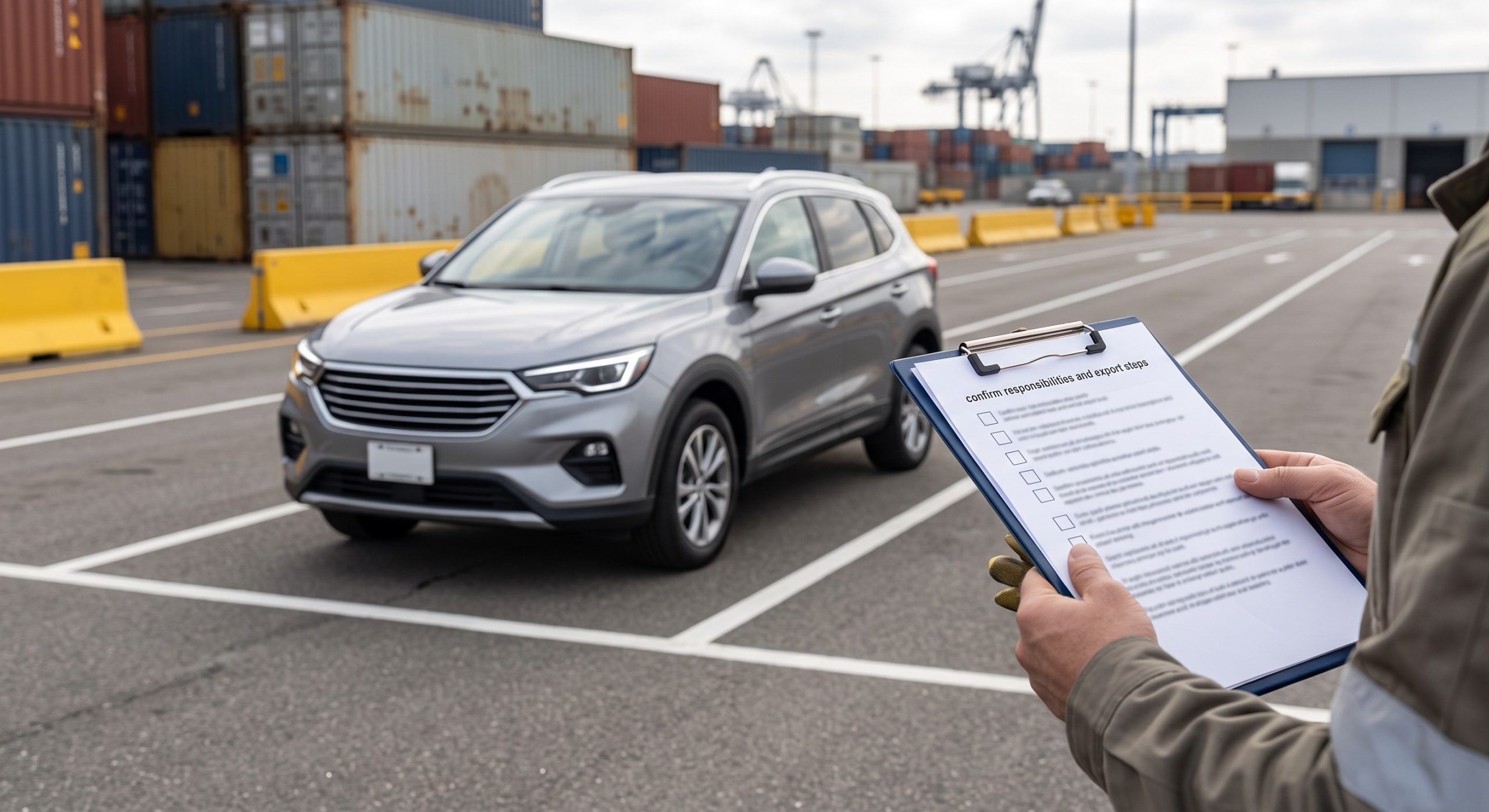
Exporting a vehicle involves more than buying the car and delivering it to a ship. Ask who is responsible for the U.S. export side of the transaction and which ownership or export documents will be prepared, submitted, or returned to you.
- Who is responsible for the export filing?
- Who checks the vehicle’s ownership documents?
- Which documents do you need from me?
- Which documents will I receive and when?
- Who should I contact if a document is delayed or rejected?
U.S. export requirements can depend on the vehicle, its documentary status, the method of export, and port procedures. Requirements can also change, so current rules should be confirmed before shipment.
Make responsibility explicit
A good answer assigns responsibility to a named party instead of assuming that “the shipping company” or “someone at the port” will handle the documents.
10. Can this vehicle be imported into my country?
A vehicle leaving the United States does not automatically mean it can be imported, registered, or legally used in every destination country. Check the rules that apply to the specific vehicle and destination before buying.
- Vehicle age restrictions
- Emissions or technical standards
- Safety requirements
- Title or damage-history restrictions
- Steering configuration
- Inspection requirements
- Taxes and duties
- Documentation requirements
- Local registration rules
Verify current destination rules
Import requirements vary by country and can change over time. Ask what the exporter knows, but independently confirm important rules with the appropriate government authority, customs professional, or qualified local expert.
Do not treat a general statement such as “we ship worldwide” as proof that a particular vehicle qualifies for import or registration in your country.
Questions to ask a U.S. car exporter before payment
Before you commit to the vehicle, make sure you can answer the following questions in a way you understand:
- Do I know the exact company I am paying?
- Do I understand what the exporter is responsible for?
- Do I have the correct VIN and current vehicle information?
- Have I reviewed available title and vehicle-history information?
- Have I considered an independent inspection?
- Do I have a written breakdown of costs and exclusions?
- Do I understand the payment terms and payment recipient?
- Do I know what happens if the transaction changes or is cancelled?
- Is responsibility for U.S. export documents clear?
- Have I checked whether this vehicle can be imported into my country?
If several answers are still unclear, get more information before sending money. A good transaction should become more understandable as you ask questions, not less.
Learn more about Export Auto USAFrequently asked questions
Start by verifying the company’s legal identity, address, contact information, invoice details, and payment recipient. Then verify the specific vehicle independently by checking the VIN, available title and history information, and current condition. No website badge, review, document, or company claim should replace basic due diligence across the transaction.
No. A vehicle history report can provide useful information about the vehicle’s past, but it cannot confirm its complete current mechanical condition. Use history information as one part of the review, then consider an independent inspection and compare the report with the VIN, title information, photos, and other current evidence.
Not automatically. Compare what each quote actually includes and excludes. One exporter may quote only the vehicle, while another may include sourcing, inland transportation, documentation, or shipping-related services. Ask for an itemized written breakdown so you can compare the same scope and identify destination costs that remain your responsibility.