

If you are buying a vehicle in the United States for export, you may face an early question: Should you buy from a U.S. car auction or from a dealer?
There is no universal winner.
An auction can give you access to a large and changing selection of vehicles, with prices decided through competitive bidding. But access rules, fees, vehicle condition, and inspection options can make the purchase more complicated.
A dealer purchase may be easier to understand. You may have more opportunity to inspect the vehicle, negotiate the price, and see clear warranty disclosures. But a dealer’s advertised price is not always the complete cost.
WHAT REALLY MATTERS
For an international buyer, the best choice depends on more than the purchase price. You also need to consider auction access, vehicle condition, total buying cost, title status, export readiness, and your tolerance for risk.
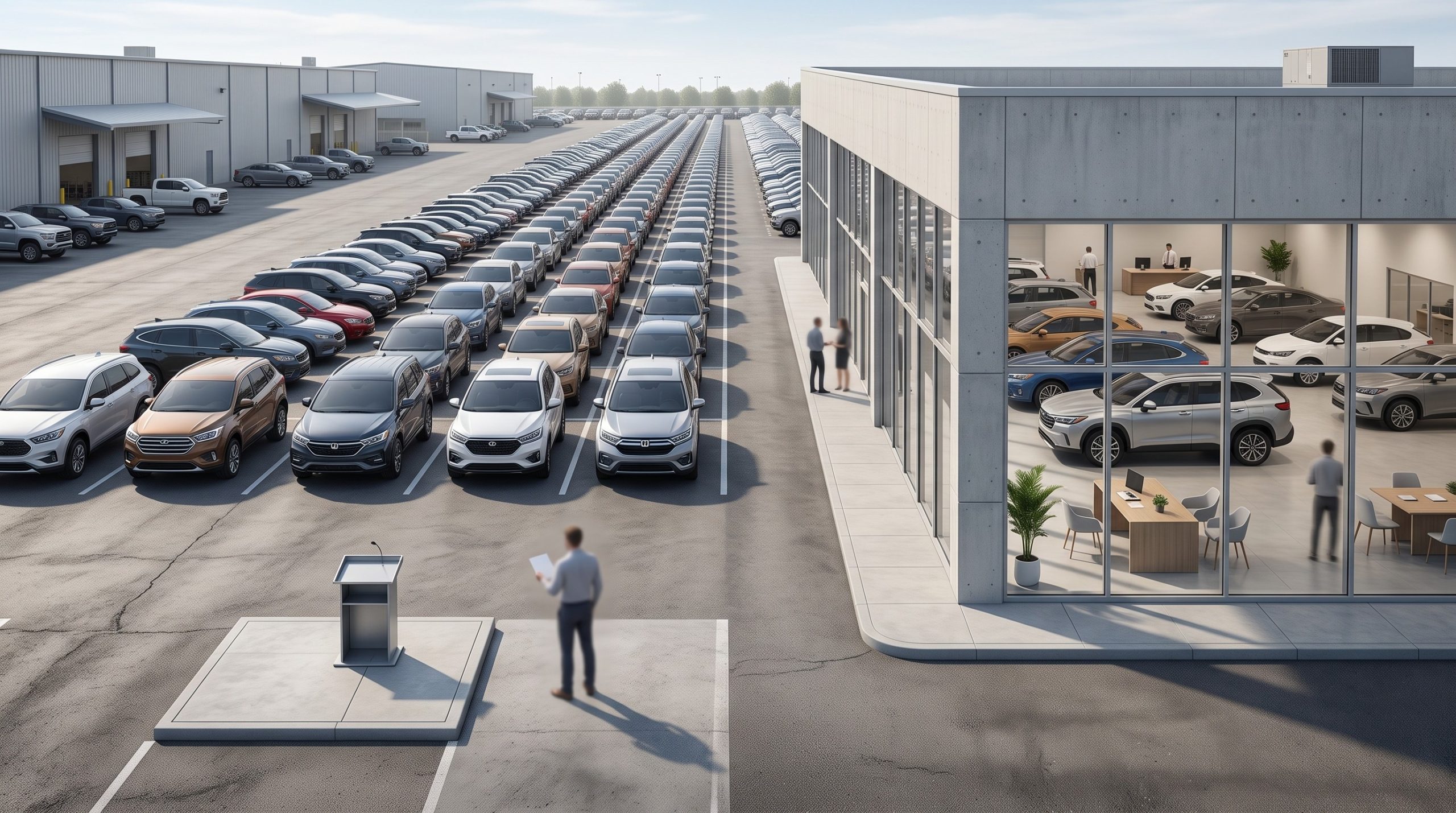
U.S. Car Auction vs. Dealer: The Main Differences
| Factor | U.S. car auction | U.S. dealer |
|---|---|---|
| Buying method | Competitive bidding or another auction sale format | Listed price, negotiation, or agreed sale price |
| Buyer access | May be public, restricted, or require business/dealer credentials | Usually designed for retail buyers |
| Price certainty | Final price is unknown until bidding ends | Price can usually be discussed before purchase |
| Extra costs | Auction and transaction fees may apply | Dealer fees and optional add-ons may apply |
| Inspection | Can be limited depending on the auction | Independent inspection may be easier to arrange |
| Test drive | May not be available | Often possible, but depends on the seller |
| Warranty | Frequently limited or sold under auction-specific terms | Used cars may be sold as-is or with warranty coverage |
| Export concern | Title and ownership documents still need to support export | Same export-document requirements apply |
The important point is that “auction” and “dealer” describe how you buy the vehicle, not whether the vehicle is automatically good or bad.
A well-researched auction vehicle may be a better purchase than a poorly researched dealer vehicle. The opposite can also be true.
1. Auction Access Can Be Complicated for International Buyers
There is no single rule that says every U.S. vehicle auction is either open or closed to international buyers.
Some auctions are primarily wholesale marketplaces.
For example, Manheim’s standard dealer registration process uses AuctionACCESS to verify authorized dealers. However, Manheim also operates selected public auction sales with their own local registration rules. (Manheim)
IAA also separates public buyers from licensed business buyers. Its current registration information says public bidding availability depends on the state and the specific vehicle. For buyers outside the United States registering as licensed businesses, IAA requires an automotive-related business license. (IAA Insurance Auctions)
Copart likewise accepts international buyers, but states that some vehicles require business credentials. Buyers who do not qualify for certain inventory may need another approved method of access. (Copart)
This means an international buyer should never assume:
- every auction is open to the public;
- every vehicle on an auction website can be purchased with the same account;
- creating an account automatically gives access to every listing; or
- another company has auction access unless that company confirms it.
Check the rules for the specific auction, vehicle, buyer type, and location before planning a purchase.
2. Do Not Compare an Auction Bid With a Dealer’s Sticker Price
Price is usually the main reason buyers become interested in auctions.
But the correct comparison is not:
auction bid vs. dealer advertised price
It is:
total acquisition cost vs. total acquisition cost
Auction platforms can charge fees in addition to the winning bid. Copart, for example, publishes a buyer-fee structure in which fees depend on factors such as the sale price and payment method. Exact auction charges vary, so the fee schedule for the specific transaction matters. (Copart)
Dealer purchases can also include costs beyond the advertised price. The Federal Trade Commission recommends asking a dealer for the total price in writing and reviewing fees and optional add-ons carefully. (Consumer Advice)
For an international buyer, your comparison may also need to consider expenses that come after the vehicle purchase, such as inland movement, export handling, shipping, and costs in the destination country.
Those costs depend on the actual vehicle and destination, so a low purchase price alone does not tell you which option is cheaper.
COMPARE TOTAL COST
A better way to compare prices
Before committing to either source, create a simple cost sheet containing:
- Vehicle purchase or maximum bid
- Auction or dealer fees
- Inspection cost
- Inland transportation
- Export-related costs
- International shipping
- Expected destination-country charges
- Repair or preparation budget
Use confirmed quotes where possible instead of estimates.
That gives you a much better basis for comparing two vehicles.
3. Vehicle Condition Can Matter More Than the Buying Channel
A low price is not useful if the vehicle requires unexpected repairs.
This is especially important when you are thousands of kilometers away and cannot inspect the car yourself.
Some auction purchases offer limited inspection opportunities. Manheim’s public-auction information, for example, says vehicles cannot be test-driven and that its public sales are sold “as is, where is,” with sales final. Other auctions and sale types can have different rules, so you need to read the terms for the specific vehicle and sale. (Manheim)
A dealer purchase may offer more opportunity for inspection, but you should not assume that a vehicle is mechanically sound simply because a dealer is selling it.
The FTC recommends obtaining an independent mechanical inspection even when a used vehicle has already been inspected or certified by a dealer. It also notes that a vehicle history report does not replace a mechanical inspection. (Consumer Advice)
For either buying route, ask:
- What condition information is available?
- Can an independent inspection be arranged?
- Are there clear photographs of important areas?
- Does the VIN match the documents and vehicle information?
- Is there a vehicle history report?
- Are known defects or damage disclosed?
- What happens if the vehicle is materially different from its description?
The answers may be more important than whether the vehicle came from an auction or a dealer.
4. A Dealer Does Not Automatically Mean a Warranty
One common mistake is assuming that an auction vehicle is “as-is” while every dealer vehicle comes with protection.
U.S. dealer rules are more specific than that.
Under the FTC Used Car Rule, most dealers selling used vehicles must provide a Buyers Guide. Among other information, the guide tells the buyer whether the vehicle is being sold as-is or with a warranty and describes applicable warranty coverage. (Federal Trade Commission)
So when comparing a dealer vehicle, check the actual Buyers Guide and sale documents rather than assuming warranty coverage exists.
International buyers should also consider a practical question:
Would any warranty still be useful after the vehicle leaves the United States?
Do not assume that it will. Read the warranty terms and confirm where and how covered repairs can be performed before giving warranty coverage significant value in your comparison.
5. Title Status Is Especially Important When the Vehicle Will Be Exported
For an international buyer, buying the vehicle is only one part of the transaction.
The vehicle also needs documentation that supports its export from the United States.
U.S. Customs and Border Protection requires specific ownership documentation for used self-propelled vehicles being permanently exported. For a U.S.-titled vehicle with a title in force, the rules generally require the original certificate of title or a certified copy, together with the required copies. CBP also requires advance submission of export information and documentation under its vehicle-export procedures. (CBP Help Center)
CHECK THIS FIRST
That makes title readiness a practical buying issue.
Before paying for a vehicle, confirm:
- what ownership document exists;
- whose name appears on it;
- whether there is a recorded lien or other ownership claim;
- whether the VIN on the vehicle and documents matches;
- when the required document will be available; and
- whether the documentation is suitable for the planned export.
CBP specifically notes additional requirements when a U.S.-titled vehicle has a recorded lien or another third-party ownership interest. (CBP)
Do not rely only on a listing description such as “clean,” “salvage,” or another short title label. Review the actual documentation and determine whether it works for both U.S. export requirements and the import requirements of your destination country.
6. When Can a U.S. Car Auction Make Sense?
An auction may be worth considering when you:
- understand the auction’s buyer-access requirements;
- are comfortable with competitive bidding;
- know your maximum total budget before bidding;
- can evaluate the available condition information;
- understand all buyer fees;
- can arrange inspection when appropriate;
- have confirmed the title and ownership-document situation; and
- are prepared for a vehicle that may need additional work.
Auctions can also be useful when you are looking for a specific configuration that is difficult to find in ordinary retail inventory.
The key is discipline.
A winning bid should not feel like winning a competition. It should simply mean that the vehicle remained inside the price and risk limits you established before bidding.
If the price goes beyond that limit, another vehicle may be the better purchase.
7. When Can Buying From a Dealer Make More Sense?
A dealer may be the easier route when you value:
- a more conventional buying process;
- the ability to discuss the price before committing;
- clearer retail-sale paperwork;
- easier access to an independent inspection;
- written disclosure of whether a used vehicle is sold as-is or with a warranty; or
- more time to review the vehicle before making a decision.
That convenience can be valuable for someone buying a U.S. vehicle for the first time.
But dealer inventory still requires due diligence.
Ask for the total price in writing. Check the vehicle history. Arrange an independent inspection where practical. Review the Buyers Guide. Confirm the title. And make sure the vehicle is suitable for export before sending payment. The FTC specifically recommends written total-price information, vehicle-history research, and independent inspection when buying used vehicles from dealers. (Consumer Advice)
8. Auction or Dealer: Which Is Better for an International Buyer?
A useful way to decide is to start with your priorities.
Consider an auction when:
You are comfortable accepting more purchase complexity in exchange for access to a different pool of vehicles and competitive bidding.
Consider a dealer when:
You prefer a more conventional transaction and place greater value on inspection access, price discussion, and retail disclosures.
Consider either when:
The individual vehicle is strong enough to justify the purchase after you consider its condition, documentation, full cost, and export suitability.
DECISION PRINCIPLE
For an international buyer, the source of the car should be secondary to the quality of the complete transaction.
A vehicle that looks inexpensive can become expensive after fees, repairs, transport, paperwork problems, and export costs.
A vehicle with a higher initial price can sometimes be the better value if its condition and documentation create fewer uncertainties.
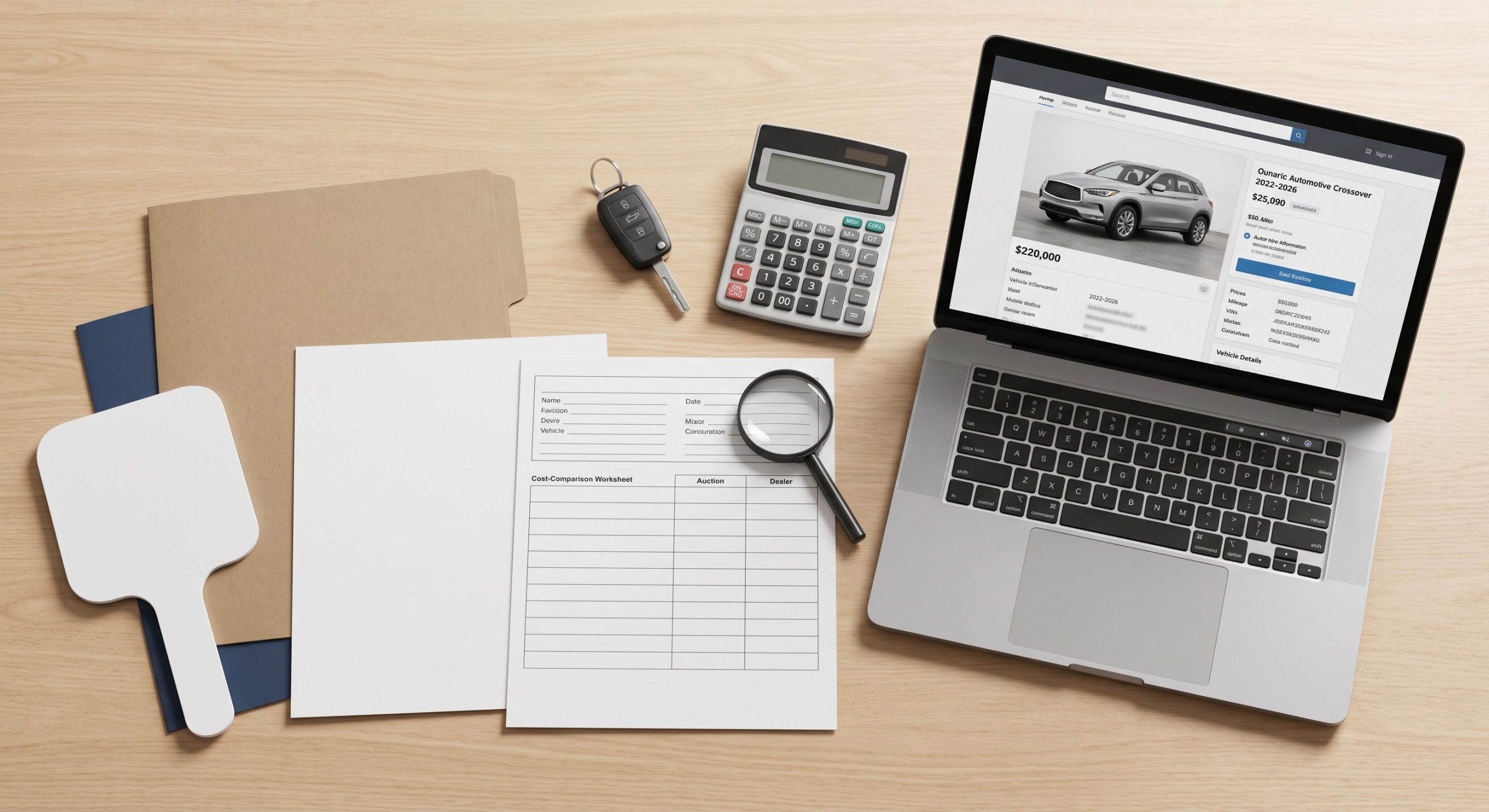
9. A Pre-Purchase Checklist for International Buyers
Before purchasing a vehicle from either a dealer or an auction, confirm these points:
Vehicle
- Correct year, make, model, trim, and specification
- VIN matches all available records
- Mileage is clearly stated
- Condition information has been reviewed
- Independent inspection considered where practical
- Vehicle history reviewed
Purchase
- Exact sale price or maximum bid established
- All known seller or auction fees identified
- Payment requirements understood
- Purchase terms read before committing
- No unwanted dealer add-ons included
Documents
- Current ownership document identified
- Title status checked
- Lien or ownership claims investigated
- Expected document-release timing confirmed
- VIN matches ownership documents
Export
- U.S. export-document requirements checked
- Destination-country import eligibility checked
- Transportation and shipping plan considered
- Estimated total landed cost reviewed before purchase
This process makes it easier to compare vehicles on facts instead of focusing only on the advertised price.
10. Start With the Vehicle You Need, Not the Selling Channel
For many international buyers, the most useful first question is not:
“Where can I find the cheapest auction?”
It is:
“What vehicle am I trying to buy, and what is the safest practical way to source it?”
Define the make, model, year range, condition, budget, destination, and any important specifications first.
Then compare individual vehicles and buying routes.
If a dealer has the right vehicle with clear documentation and an acceptable total cost, that may be the better choice.
If an appropriate auction vehicle can be purchased under acceptable access, condition, documentation, and cost terms, that may be the better choice instead.
The source should serve the buying decision—not control it.
FAQ: U.S. Car Auctions vs. Dealers
Sometimes, but not from every auction or for every vehicle. Access depends on the auction company, location, buyer type, and vehicle. Manheim has selected public auctions while its main wholesale registration uses dealer authentication. IAA allows public buying only where permitted and places additional requirements on licensed business accounts. Copart also has different requirements depending on the inventory being purchased. (Manheim)
No. An auction may produce a lower vehicle price, but the winning bid is not necessarily the total cost. Auction fees, inspection, transportation, repairs, export handling, and shipping can change the comparison. Dealer transactions can also contain fees and optional add-ons. Compare the complete cost of each vehicle rather than only the advertised price or winning bid. (Copart)
Not automatically. Buying from a dealer may give you better opportunities to arrange an inspection and review retail-sale disclosures, but the individual vehicle still needs research. The FTC recommends a vehicle history report and an independent mechanical inspection when buying a used vehicle from a dealer. (Consumer Advice)
Not all of them. The FTC Buyers Guide tells consumers whether a dealer is selling a used vehicle as-is or with warranty coverage. Always read the specific Buyers Guide and warranty documents. (Federal Trade Commission)
Check the vehicle’s identity and condition, the total purchase cost, title and ownership documents, VIN accuracy, any liens, and whether the documentation will support U.S. export and import into your destination country. CBP has specific documentation and advance-filing requirements for permanent export of used self-propelled vehicles. (CBP Help Center)
Looking for a Specific Vehicle in the U.S.?
You do not need to choose a buying channel before you know which vehicle fits your needs.
Tell ExportAutoUSA what vehicle you are looking for, your budget, destination, and other important requirements.
Start with Request a Car to share what you need and discuss the next steps.