
Finding several attractive cars for sale in the USA is often the easy part. Choosing between them can be much harder.
Two vehicles may look almost identical in photos but have different mileage, equipment, maintenance histories, previous damage, seller terms, or mechanical condition. For an international buyer, those differences matter because resolving a problem after the vehicle has been purchased can be much more difficult than identifying it beforehand.
COMPARISON PRINCIPLE
The best approach is to compare each vehicle in the same order and using the same criteria. Price matters, but it should not be the only deciding factor.
This guide explains what to compare before you choose a U.S. vehicle for export.
Start by Comparing Similar Vehicles
A useful comparison begins with cars that are genuinely comparable.
Check the complete specification of each vehicle, including:
- model year;
- make and model;
- trim level;
- engine;
- transmission;
- drivetrain;
- mileage;
- major factory options;
- overall condition.
A lower price may simply mean that one vehicle has a different trim, fewer features, higher mileage, or a condition issue.
When possible, compare vehicles with similar specifications first. This gives you a much clearer picture of whether the asking price is attractive.
Do not compare only by model name
A model can have several trim levels and mechanical configurations.
For example, two SUVs from the same year can differ in drivetrain, engine, seating configuration, safety equipment, wheels, interior features, or optional packages.
Before deciding that one is cheaper, confirm that you are comparing like with like.
Compare the Asking Price — Then Look Beyond It
The advertised price is an important starting point, but it does not tell you everything about the purchase.
For dealer vehicles, the Federal Trade Commission recommends asking for written pricing information and checking the terms carefully rather than relying only on the advertised number. (Consumer Advice)
When comparing two vehicles, consider:
| Factor | Vehicle A | Vehicle B |
|---|---|---|
| Asking price | ||
| Year and trim | ||
| Mileage | ||
| Reported history | ||
| Service records | ||
| Visible condition | ||
| Inspection findings | ||
| Tires and other immediate needs | ||
| Seller-provided information | ||
| Documentation to verify |
A vehicle with a slightly higher purchase price may be the better choice if its condition and history reduce uncertainty.
The goal is not simply to find the cheapest car. It is to understand what you are getting for the price.
Compare Mileage in Context
Mileage is easy to compare because it gives you a clear number. But lower mileage does not automatically mean a better vehicle.
Look at mileage together with:
- vehicle age;
- maintenance records;
- mechanical condition;
- previous use;
- overall wear.
A well-maintained higher-mileage vehicle can sometimes be a more attractive candidate than a lower-mileage vehicle with poor maintenance or unexplained history.
Also compare the mileage shown in the listing with information available in the vehicle’s records. U.S. vehicle-history resources can include reported odometer information that helps buyers identify inconsistencies. (VehicleHistory)
If the numbers do not make sense, investigate before proceeding.
Review the VIN and Vehicle History
Once a vehicle makes your shortlist, request its VIN — the Vehicle Identification Number — and review available history information.
The U.S. Federal Trade Commission recommends obtaining a vehicle history report before buying a used car. It also notes that history reports may contain information about previous ownership, accidents, repairs, or salvage history, depending on the report and its data sources. (Consumer Advice)
One official U.S. resource is the National Motor Vehicle Title Information System, or NMVTIS. Its reports can provide information such as state title records, reported odometer data, brand history, and certain salvage or total-loss information. (VehicleHistory)
Use this information as part of your comparison rather than as a simple pass-or-fail test.
For example:
Vehicle A
- lower price;
- limited maintenance information;
- previous damage reported.
Vehicle B
- slightly higher price;
- more complete history;
- consistent mileage records;
- documented maintenance.
Vehicle B may justify further consideration even though its asking price is higher.
IMPORTANT
A history report is not an inspection
This distinction is important.
The FTC specifically recommends an independent vehicle inspection in addition to checking a vehicle’s history. A report can tell you what has been recorded about a vehicle, but it cannot confirm its complete mechanical condition today. (Consumer Advice)
Treat history and inspection as two separate parts of the comparison.
Compare Maintenance and Service Records
Ask what maintenance information is available for each vehicle.
Useful records may help you understand whether routine maintenance was performed and whether major repairs have already taken place. The U.S. government’s NMVTIS buying guidance also recommends asking for maintenance records when evaluating a used vehicle. (VehicleHistory)
Do not assume that no records means no maintenance. Records can be incomplete.
However, when one vehicle has clear supporting information and another has very little, that difference should form part of your risk assessment.
Pay particular attention when the seller’s description conflicts with the information you can independently verify.
Compare Actual Condition, Not Just Listing Photos
Online photographs are useful for creating a shortlist. They are not enough to confirm a vehicle’s condition.
Look carefully at available images for:
- body-panel alignment;
- paint differences;
- dents and scratches;
- corrosion;
- wheel and tire condition;
- glass damage;
- interior wear;
- warning lights if the dashboard is shown;
- signs of previous repairs.
General used-car inspection guidance also recommends examining body condition, tires, interior components, mechanical systems, and signs of previous damage rather than relying only on appearance. (Edmunds)
If important areas are not shown, ask for more information before moving the vehicle higher on your shortlist.
Use an Independent Pre-Purchase Inspection When Appropriate
A professional pre-purchase inspection can provide information that is difficult to obtain from photos and history reports alone.
The FTC recommends an independent inspection when buying a used vehicle, even when a history report is available. (Consumer Advice)
Depending on the vehicle, an inspection may help identify concerns involving:
- engine or transmission operation;
- leaks;
- suspension;
- brakes;
- tires;
- previous repairs;
- body or structural condition;
- warning lights;
- electrical equipment.
The purpose is not only to find faults. Inspection findings give you a better basis for comparing two otherwise similar vehicles.
If Vehicle A needs several immediate repairs while Vehicle B does not, the lower asking price of Vehicle A may become less attractive.

Check for Open Safety Recalls
A VIN can also be used with the U.S. National Highway Traffic Safety Administration’s recall lookup.
NHTSA says its VIN search can show unrepaired safety recalls for vehicles from participating manufacturers, although the database also has limitations and does not display every possible past recall situation. (NHTSA)
An open recall does not automatically mean that a vehicle should be rejected. It is another fact to understand before making a decision.
If one of your shortlisted cars has an unresolved recall, find out what is involved before you purchase it.
Compare the Seller Information Too
You are not only comparing cars. You are also comparing the quality of the information available about each car.
A useful listing should make it reasonably easy to identify what is being offered.
Be more cautious when:
- the VIN is unavailable without explanation;
- important specifications are missing;
- the mileage is unclear;
- photos do not show important areas;
- statements in the listing conflict with other records;
- the seller will not answer reasonable questions;
- an independent inspection cannot be arranged when one is needed.
The FTC advises used-car buyers to research the seller and verify vehicle information rather than relying only on the advertisement. (Consumer Advice)
More information does not guarantee a good vehicle, but missing or conflicting information makes a reliable comparison more difficult.
Check Whether the Vehicle Fits Your Destination Before Buying
A vehicle that looks attractive in the U.S. market may not automatically be the best vehicle for use in another country.
Before finalizing your choice, confirm the relevant requirements in your destination country with the appropriate authorities or qualified professionals.
You may also want to consider practical questions such as:
- Is this engine and model commonly serviced where the vehicle will be used?
- Are replacement parts reasonably available?
- Is the vehicle configuration suitable for the buyer’s intended use?
- Does the buyer understand the vehicle’s fuel type, drivetrain, dimensions, and equipment?
- Have the necessary ownership and export-document questions been verified before purchase?
DOCUMENTATION NOTE
U.S. Customs and Border Protection has specific requirements concerning documentation for exporting used self-propelled vehicles, so documentation should be checked as part of the buying process rather than after a vehicle has already been selected. Exact procedures should be confirmed for the specific export rather than assumed from a general buying guide. (CBP Help Center)
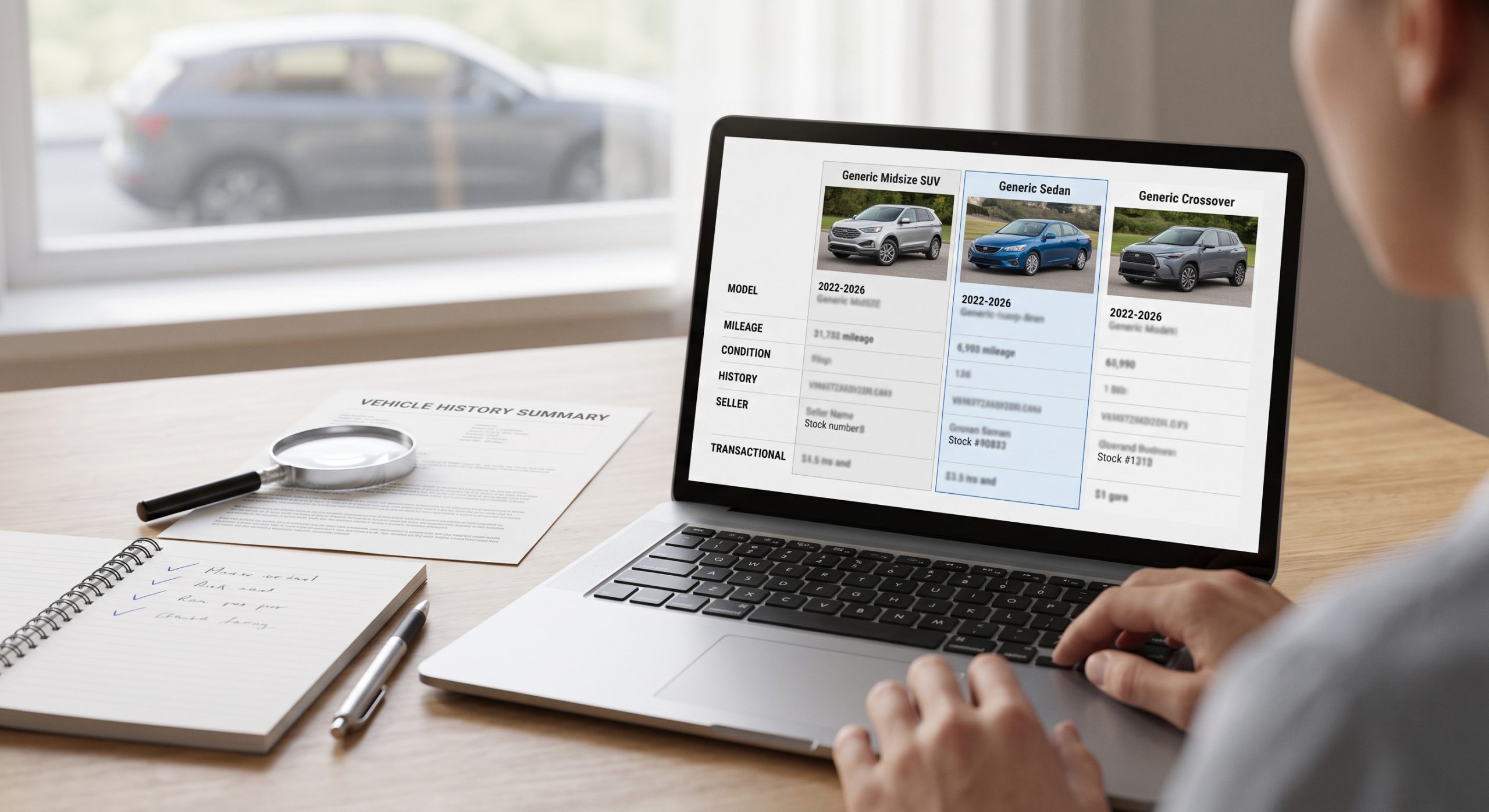
Create a Shortlist Before Making a Final Decision
Trying to compare ten or twenty vehicles in detail is inefficient.
A better process is to reduce the search to two or three serious candidates.
First screening
Remove vehicles that clearly fail your basic requirements for:
- budget;
- model;
- year;
- mileage;
- engine or drivetrain;
- major equipment;
- obvious condition concerns.
Second screening
For the remaining vehicles, compare:
- exact specification;
- asking price and seller-provided pricing information;
- mileage;
- vehicle history;
- maintenance information;
- physical condition;
- inspection findings;
- unresolved questions;
- documentation that still needs verification.
This makes it easier to see why one vehicle deserves to rank above another.
Do Not Let One Attractive Number Decide the Purchase
International buyers can easily focus on one strong number:
the lowest price, the newest year, or the lowest mileage.
None of those factors should normally be considered alone.
Imagine three similar vehicles:
Car A
Lowest asking price, but higher mileage and little maintenance information.
Car B
Moderate price, consistent history information, documented maintenance, and a satisfactory inspection.
Car C
Lowest mileage, but important questions about its condition remain unanswered.
Car A may still be the right choice if its condition is good and the numbers make sense. Car C may also become the strongest option after further verification.
The important point is that you should not choose until you understand why the vehicles are priced differently.
A Simple Used-Car Comparison Checklist
Before choosing a U.S. vehicle for export, ask:
- Am I comparing the same model, trim, engine, and drivetrain?
- How do the year and mileage compare?
- What information is available from the VIN and vehicle history?
- Are mileage records consistent?
- Are maintenance records available?
- What does the vehicle’s current condition look like?
- Has an independent inspection been considered or completed?
- Are there unresolved safety recalls?
- Is the seller providing enough information to make a decision?
- What repairs or maintenance may be needed soon?
- Have destination-country requirements been checked separately?
- Have ownership and export-document questions been verified before purchase?
If you cannot answer an important question, treat it as an open item rather than assuming everything is fine.
The Best Car for Export Is Not Always the Cheapest Car
A good comparison turns a long list of cars for sale into a smaller group of vehicles you can evaluate with more confidence.
Start with cars for sale in the USA that have comparable specifications. Then compare selected vehicles side by side, examining price, mileage, history, maintenance, condition, inspection findings, recalls, and documentation.
Most importantly, verify information before committing to a vehicle.
Frequently Asked Questions
There is no single factor that tells the whole story. Compare specification, price, mileage, vehicle history, maintenance, actual condition, inspection findings, and any unresolved documentation questions together. You can also read frequently asked questions about buying and exporting a vehicle for more information, or learn more about ExportAutoUSA.
No. Mileage should be considered together with age, maintenance, history, and current mechanical condition. A lower odometer reading does not by itself confirm that a vehicle is in better condition.
Yes. Online listings, specifications, VIN information, history reports, photos, and seller responses can help you create a shortlist. An independent inspection can then provide additional information about the condition of the most serious candidates. The FTC recommends using both history information and an independent inspection when evaluating a used vehicle. (Consumer Advice)
Yes. NHTSA provides a VIN-based recall lookup that can identify certain unrepaired safety recalls. (NHTSA)
Yes. Do not assume that every vehicle has the same documentation or destination-country requirements. Verify the requirements relevant to the specific vehicle and destination before committing to the purchase. U.S. export requirements should be confirmed through current CBP guidance or the professionals handling the export. (CBP Help Center)
Request a Car
If you already know the make, model, year, budget, or specifications you want but have not found the right option, you can use Request a Car to tell ExportAutoUSA what you are looking for.